The medical device industry has always operated at the intersection of innovation, regulation, and patient impact. Precision, compliance, and deep expertise are foundational to success. What has changed is the pace at which the industry is evolving and the pressure this places on the workforce that supports it.
Devices are becoming more connected and data-driven. AI is influencing how products are designed, validated, manufactured, and supported. Regulatory expectations continue to expand, while competition for skilled talent remains intense across nearly every critical function. Throughout this series, we’ve examined how these forces are reshaping hiring across field service, quality and regulatory, engineering, and sales. When viewed together, they point to a broader reality: workforce strategy is no longer a supporting function. It has become a competitive imperative.
Many medical device organizations are already feeling the effects of talent shortages in tangible, operational ways. As we explored in The Field Service Talent Crisis in Medical Device, unfilled field service roles can delay installations, increase downtime, and strain customer relationships. Similar challenges appear in quality and regulatory functions, where gaps can increase audit risk and slow product timelines, as discussed in The Rising Demand for QMS Talent in Medical Device. Sales vacancies disrupt territory coverage and lengthen already complex buying cycles, while engineering roles remain open even as innovation roadmaps continue to move forward. These are not isolated recruiting challenges. They directly affect uptime, compliance, revenue continuity, and customer confidence.
At the same time, the skills required to succeed in these roles are changing faster than many hiring models are adapting. AI-enabled diagnostics, predictive maintenance, digital quality systems, and connected devices are reshaping how work gets done across the medical device lifecycle. We explored this shift in depth in AI Is Redefining the Skills Your Medical Device Workforce Needs, where traditional experience-based requirements no longer align with the capabilities teams need today. Yet many hiring models still rely on narrow definitions of prior industry experience, limiting access to talent at a moment when adaptability, learning agility, and cross-functional skill sets matter as much as tenure.
Forward-looking medical device companies are responding by shifting toward skills-first hiring approaches that expand access without sacrificing rigor. As outlined in Stop Hiring for Experience: A Growth Imperative for Life Sciences, organizations that focus on competencies rather than résumés are better positioned to build resilient teams. Rather than competing endlessly for the same limited pool of industry insiders, they are identifying transferable capabilities from adjacent industries and investing in structured onboarding and development. Military technical specialists, industrial automation professionals, regulated manufacturing operators, and healthcare IT talent often bring the discipline, problem-solving ability, and compliance mindset required to succeed when supported with the right training.
Another theme that emerged across this series is the risk of reactive hiring. Waiting for a vacancy to open before engaging candidates leaves organizations vulnerable to extended gaps and operational disruption. In Addressing the Talent Shortage in the Medical Device Industry, we examined how proactive pipeline strategies create continuity by allowing leaders to anticipate turnover, plan coverage, and develop future talent before needs become urgent. This is especially critical in roles with long ramp times and high business impact, including field service, quality, and specialized sales.
Employment brand also plays a more significant role than many organizations realize, even when hiring is not immediately urgent. In Why Employment Brand Matters in Medical Device, Even When You’re Not Hiring, we explored how workforce stability and engagement serve as visible signals to customers, partners, and regulators. A strong employment brand supports retention, reduces turnover risk, and reinforces confidence in an organization’s ability to deliver consistent quality over time.
Taken together, these insights lead to a clear conclusion. Medical device organizations that succeed in the years ahead will be those that intentionally design their workforce strategy. They will align hiring with evolving skill requirements, build pipelines rather than reacting to vacancies, and treat talent decisions as an integral part of their operational and growth strategy.
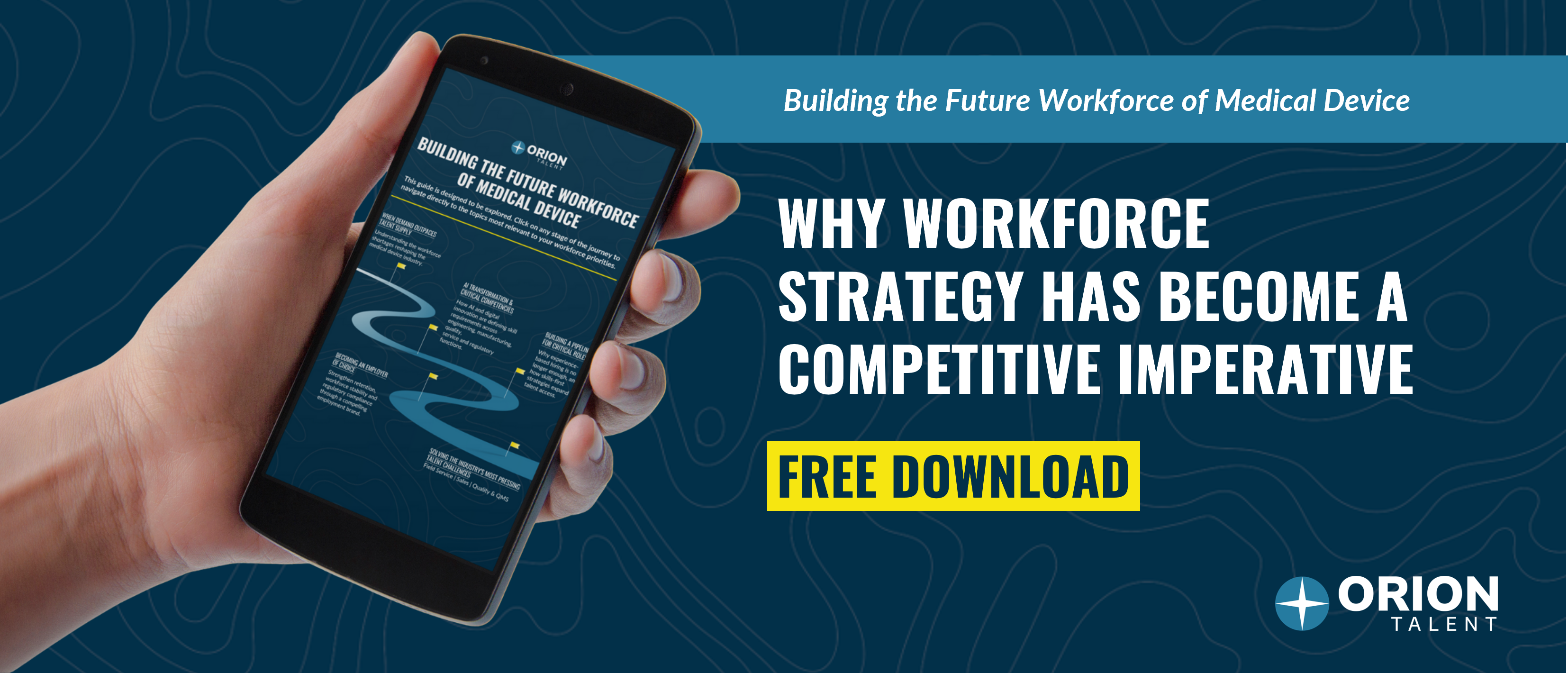
To help leaders think holistically about what this looks like in practice, we created a comprehensive guide.
A practical guide for building a future-ready workforce
Building the Future Workforce of Medical Device brings together the themes explored across this series and provides a clear framework for workforce planning in today’s environment.
The guide explores:
- Where talent demand is outpacing supply across critical roles
- How AI and digital transformation are reshaping skill requirements
- Why skills-first hiring is becoming a competitive advantage
- Practical approaches to building durable talent pipelines
Download the guide: Building the Future Workforce of Medical Device
At Orion Talent, we partner with medical device organizations to build future-ready teams across engineering, quality, field service, sales, and operations. If you are rethinking how talent supports growth, compliance, and innovation, this guide is a strong place to start.
Archives
- October 2026
- September 2026
- August 2026
- July 2026
- June 2026
- May 2026
- April 2026
- March 2026
- February 2026
- January 2026
- December 2025
- November 2025
- October 2025
- September 2025
- August 2025
- July 2025
- June 2025
- May 2025
- April 2025
- March 2025
- February 2025
- October 2024
- May 2024
- March 2024
- February 2024
- January 2024
- December 2023
- November 2023
- October 2023
- September 2023
- August 2023
- July 2023
- June 2023
- May 2023
- April 2023
- March 2023
- February 2023
- January 2023
 RSS Feed