Written by: Stefan Lint, Talent and Workforce Solutions Advisor
Most life sciences leaders still believe that growth comes from hiring people who know the industry. It is an understandable instinct. Scientific precision, regulatory demands, and complex product lifecycles make deep domain experience feel like the safest path.
But in a labor market defined by talent shortages and shifting skill requirements, that belief is becoming a constraint. Companies that rely exclusively on experience-based hiring are shrinking their talent pools, slowing their innovation cycles, and missing out on high-performing candidates who have the right competencies but not the traditional résumé.
The first post in this series explored the industry’s most persistent talent shortages across engineering, field service, quality, regulatory, sales, and operations. In our second post, we looked at how AI is reshaping the skills required across all of these functions.
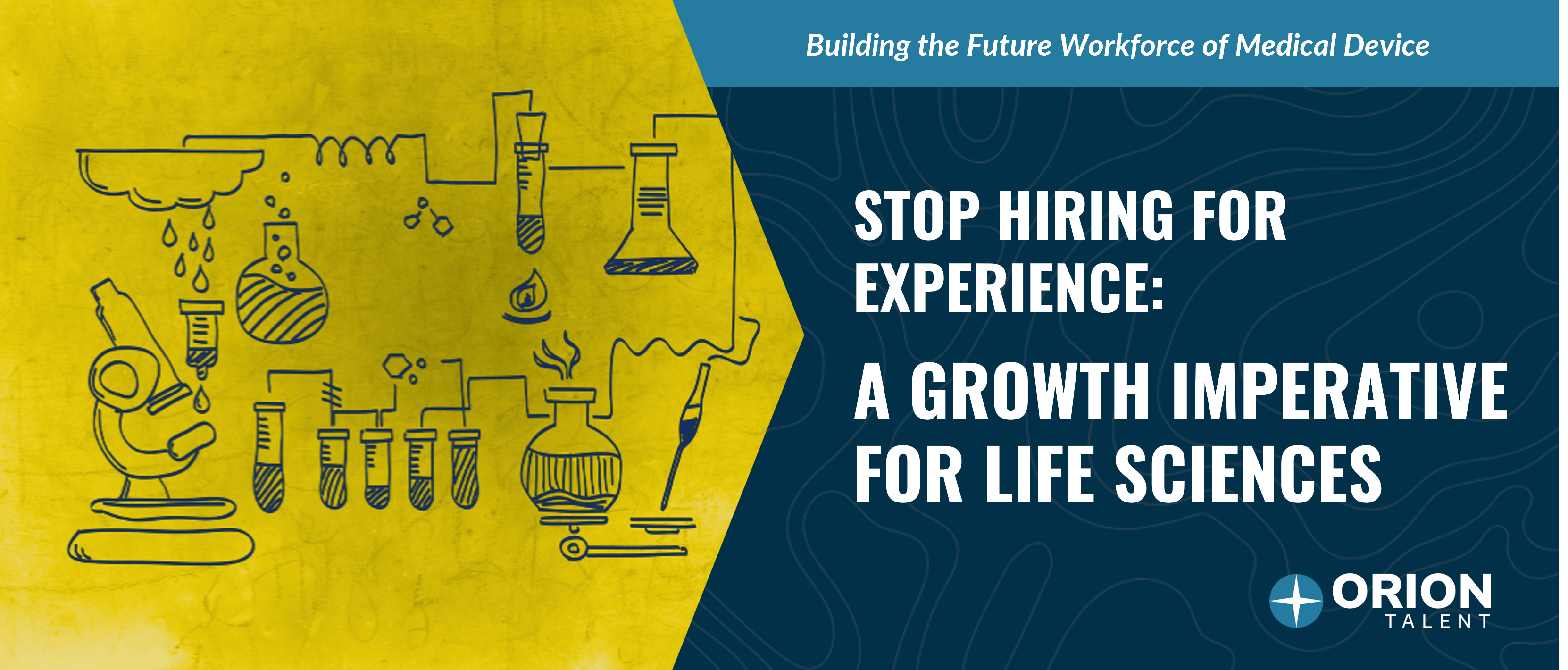
In this post we will explain why hiring for experience alone is no longer enough to sustain growth in Life Sciences.
The 10 Competencies That Drive Growth
Life sciences firms cannot outgrow their workforce capabilities. The technical, regulatory, and commercial challenges ahead demand ten critical competencies, none of which can be left to chance.
1. Scientific and Technical Mastery
Deep scientific knowledge remains essential, but teams now must translate that expertise into faster product cycles and smarter design.
Relevant skills: product design controls, molecular biology techniques, process validation.
2. Regulatory and Compliance Intelligence
In an environment defined by FDA scrutiny, teams that anticipate compliance will improve speed and trust.
Relevant skills: FDA 510(k) and PMA submission processes, ISO 13485 and GMP compliance, audit management.
3. Data Literacy and Bioinformatics
Discovery is no longer enough. The competitive edge lies in data-driven insights.
Relevant skills: Python or R, machine learning for clinical insights, data visualization.
4. Project and Program Leadership
Complex product pipelines require coordination, not just management.
Relevant skills: Agile project management, risk management, cross-functional orchestration.
5. Innovation Agility
Top performers thrive in cultures of experimentation.
Relevant skills: design thinking, rapid prototyping, technology scouting.
6. Market and Commercial Strategy
Growth requires translating science into patient and customer value.
Relevant skills: competitive intelligence, go-to-market strategy, HEOR.
7. Cross-Functional Collaboration
Breakthroughs occur at the intersection of disciplines.
Relevant skills: stakeholder alignment, interdisciplinary communication, digital collaboration.
8. Ethical Decision-Making
In sectors that impact lives, ethics is a competitive differentiator.
Relevant skills: clinical trial ethics, patient data privacy, conflict-of-interest management.
9. Adaptability and Lifelong Learning
With job growth outpacing the national average, adaptability is essential.
Relevant skills: resilience, continuous learning, upskilling in digital health.
10. Leadership and Change Management
Growth is ultimately about people.
Relevant skills: coaching and mentoring, strategic communication, organizational transformation.
Why Experience-Based Hiring Is No Longer Enough
Experience alone does not guarantee competency, especially as roles evolve. For example:
- A regulatory leader with decades of experience may lack AI fluency.
- A field service engineer with years of device expertise may struggle in a predictive maintenance model.
- An engineer trained on legacy systems may not be equipped for connected device ecosystems.
The companies that will lead the next decade of innovation are those that hire for capability, not just history.
What a Skills-First Hiring Strategy Looks Like
A modern workforce strategy prioritizes:
- Competency-based interviews
- Transferable skills from adjacent industries
- Internal mobility and cross-training
- Structured onboarding and development programs
- Talent pipelines built around capabilities, not tenure
Competency-driven hiring expands access to talent, strengthens long-term potential, and builds a workforce that can adapt as technologies evolve.
Ready to Strengthen your Medical Device Workforce?
Check out our Medical Device talent solutions to learn more about how Orion helps companies build skilled, future-ready teams across engineering, quality, field service, sales and operations
Archives
- October 2026
- September 2026
- August 2026
- July 2026
- June 2026
- May 2026
- April 2026
- March 2026
- February 2026
- January 2026
- December 2025
- November 2025
- October 2025
- September 2025
- August 2025
- July 2025
- June 2025
- May 2025
- April 2025
- March 2025
- February 2025
- October 2024
- May 2024
- March 2024
- February 2024
- January 2024
- December 2023
- November 2023
- October 2023
- September 2023
- August 2023
- July 2023
- June 2023
- May 2023
- April 2023
- March 2023
- February 2023
- January 2023
 RSS Feed