
The period between offer acceptance and start date is often treated as administrative. Background checks, onboarding paperwork, compliance requirements, and system access are processed. Recruiting transitions ownership. HR prepares documentation. Hiring managers turn their focus back to operational demands.
Yet this transition window is one of the most fragile points in the employment lifecycle.
The graphic below illustrates where talent leakage most often occurs between offer acceptance and Day One. While the breakdowns may appear operational in nature, they signal deeper coordination gaps across Talent Acquisition, HR, and operations.
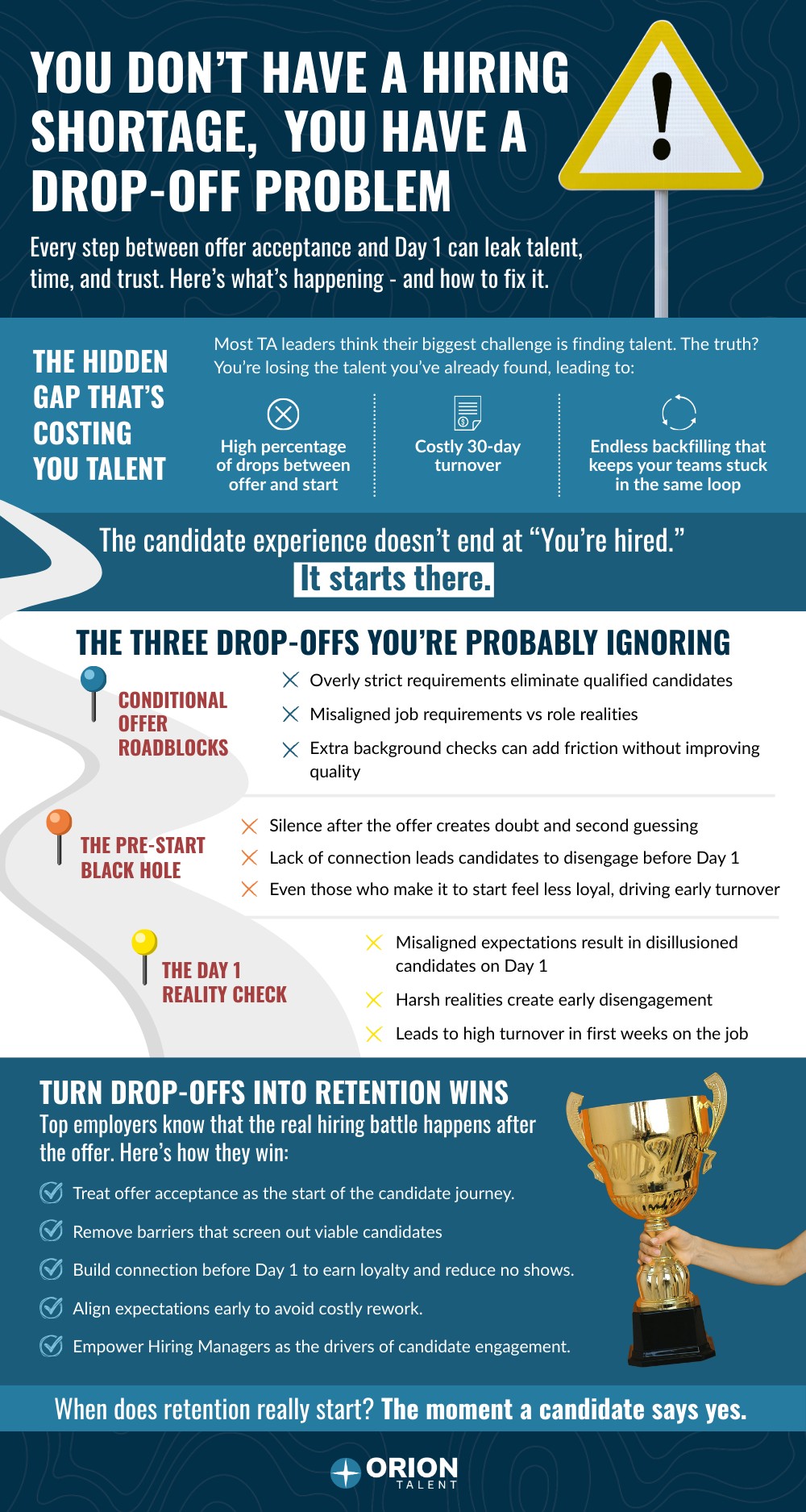
The Steps that Leak Time, Talent and Trust
First, conditional offer friction. Requirements that feel disconnected from the role, slow-moving approvals, or unclear expectations introduce doubt at the very moment commitment should be solidifying. Candidates who were enthusiastic during interviews begin to question alignment.
Second, prolonged silence between acceptance and start date. In competitive markets, a lack of structured communication creates space for competing offers, counteroffers, and second guessing. Even when candidates ultimately show up, the absence of early engagement weakens the psychological contract before employment begins.
Third, the Day One reality check. When the lived experience of the job does not align with what was communicated during recruitment, trust erodes quickly. In environments where productivity ramps are critical, early disengagement has immediate operational consequences.
For the CHRO, these are not isolated recruiting breakdowns. They represent systemic misalignment across the workforce system.
The Financial and Operational Implications
Early turnover within the first 90 days compounds cost in ways that extend well beyond recruiting expense. Roles must be reopened and refilled. Productivity ramps reset. Existing employees absorb additional workload, increasing burnout risk and reducing engagement. In advanced manufacturing and highly regulated environments, staffing instability can delay output, increase compliance risk, and disrupt quality controls.
Even when attrition does not occur, weakened early engagement slows time to full productivity. A new hire who begins with uncertainty or misaligned expectations is less likely to integrate quickly into performance rhythms. That delay carries measurable impact.
Organizations that do not explicitly measure and manage the offer-to-start transition often find themselves investing heavily at the top of the funnel while leakage persists downstream. The result is a cycle of continuous hiring activity without corresponding stability gains.
Candidate Experience as a Workforce System
The phrase “candidate experience” is frequently framed as a branding or recruiting concern. For CHROs, it should be viewed differently.
Candidate experience is the front end of retention strategy and a leading indicator of workforce stability. It tests whether the organization is aligned across functions before employment even begins.
Workforce Orchestration requires intentional coordination across people, process, and technology throughout the employment lifecycle. That coordination must include the transition between offer and Day One. Clear accountability, shared metrics, structured communication cadences, and active hiring manager engagement are not optional enhancements. They are foundational controls within a modern workforce operating model.
Technology can reduce friction. Automation can increase communication speed. AI can support screening and engagement. But without coordinated ownership and alignment, even the most advanced tools cannot prevent early commitment breakdown.
The organizations that win in constrained labor markets are not simply those that source effectively. They are those that protect talent commitment after it is secured.
For the CHRO, the hiring battle does not end at offer acceptance. In many ways, it begins there. In the next article in this series, we will examine five structural upgrades organizations are implementing to convert candidate experience from a transactional process into a measurable retention lever.
Archives
- September 2026
- August 2026
- July 2026
- June 2026
- May 2026
- April 2026
- March 2026
- February 2026
- January 2026
- December 2025
- November 2025
- October 2025
- September 2025
- August 2025
- July 2025
- June 2025
- May 2025
- April 2025
- March 2025
- February 2025
- October 2024
- May 2024
- March 2024
- February 2024
- January 2024
- December 2023
- November 2023
- October 2023
- September 2023
- August 2023
- July 2023
- June 2023
- May 2023
- April 2023
- March 2023
- February 2023
- January 2023
 RSS Feed