

Guest Post by Angeline Kroeck and Jericho Urmenita
When Steven Bartlett, Diary of a CEO Founder, hired a candidate with “zero experience” because she thanked the security guard by name, the story quickly circulated as an inspiring example of character outweighing credentials. It was framed as a bold leadership moment. For CHROs, however, the more important question is not whether the story resonates emotionally, but whether it reflects a measurable shift in how the labor market assigns value.
To move beyond anecdote, Orion Talent’s Market Intelligence team analyzed 3.9 million job postings from late 2024 through December 2025. The objective was to determine whether human capability is genuinely overtaking technical proficiency as the primary differentiator in hiring decisions. The data suggests that this is not a temporary blip. It signals a broader structural evolution in workforce demand.
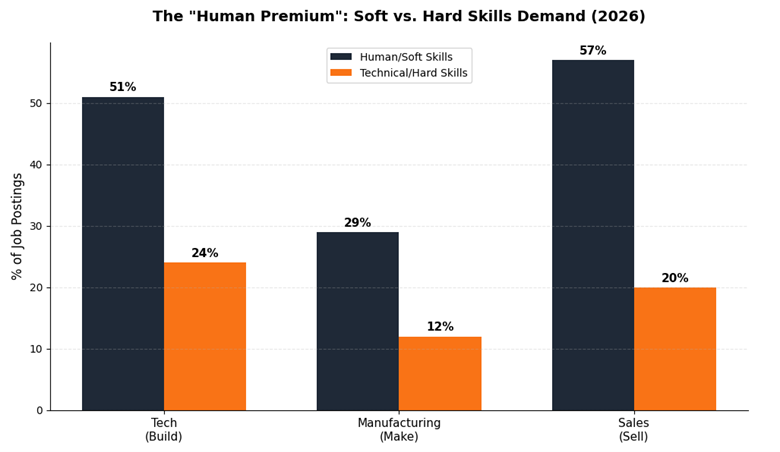
The Rise of the Human Premium
Across Technology, Manufacturing, and Sales, human skills now consistently outrank hard skills in employer demand.
- In Technology, employers are more than twice as likely to request communication as they are Python. Even in roles traditionally defined by coding expertise, the ability to collaborate and communicate has become more critical than mastery of a specific language.
- In Manufacturing, communication has overtaken machinery as the most requested skill, indicating that coordination and teamwork are increasingly valued alongside operational capability.
- In Sales, customer service demand significantly exceeds specific selling techniques, reflecting a shift from transactional selling toward relational advising.
The pattern is consistent across the Make, Build, and Sell economy: human skills are rising in relative importance.
This shift aligns with a broader market reality. Technical skills are increasingly susceptible to automation and rapid obsolescence, while human capabilities such as curiosity, resilience, strategic thinking, and communication compound in value over time. Even highly technical roles are now differentiated not only by tool proficiency, but by problem solving and judgment. In this context, technical skills function as depreciating assets, while human skills behave as appreciating ones.
Designing the Workforce for Long-Term Performance
For CHROs, this fundamentally changes how roles should be defined and how risk should be evaluated. Hiring exclusively for experience may appear to reduce uncertainty, yet in an environment where technical proficiency can be automated or reskilled within shorter cycles, rigid experience requirements can constrain adaptability and slow workforce evolution. When job definitions overemphasize tenure or narrow tool expertise, organizations shrink their potential talent pools and intensify competition for skills that may soon shift.
Workforce orchestration begins upstream, at the point where value is assigned and roles are designed. Organizations responding effectively to this Human Premium do not lower standards. They recalibrate them. They define roles around capability and learning velocity rather than years of experience alone. They evaluate potential alongside present proficiency. They invest in onboarding and development systems that accelerate ramp and reinforce adaptability instead of screening solely for past exposure.
Viewed through this lens, the “Zero-Experience Hire” is not about abandoning rigor. It reflects a structural reordering of value in the labor market. A resume captures what a candidate can do today, but character, cognitive agility, and communication often determine what they can achieve tomorrow.
For CHROs responsible for long-term workforce performance, recognizing that distinction is no longer optional, but has become foundational.
Archives
- October 2026
- September 2026
- August 2026
- July 2026
- June 2026
- May 2026
- April 2026
- March 2026
- February 2026
- January 2026
- December 2025
- November 2025
- October 2025
- September 2025
- August 2025
- July 2025
- June 2025
- May 2025
- April 2025
- March 2025
- February 2025
- October 2024
- May 2024
- March 2024
- February 2024
- January 2024
- December 2023
- November 2023
- October 2023
- September 2023
- August 2023
- July 2023
- June 2023
- May 2023
- April 2023
- March 2023
- February 2023
- January 2023
 RSS Feed