
As semiconductor employers expand their search for technical talent, many are looking beyond traditional industry boundaries and geographic markets to identify new workforce sources.
One talent pipeline that continues to demonstrate strong alignment with semiconductor workforce needs is the military community.
While military hiring is often discussed in the context of diversity, veteran employment, or workforce development initiatives, it also represents a practical solution to many of the technical and operational challenges facing semiconductor manufacturers today.
Labor market data shows a measurable flow of military talent into semiconductor-adjacent occupations, reinforcing the transferability of skills developed through military service.
The Skills Alignment Is Stronger Than Many Employers Realize
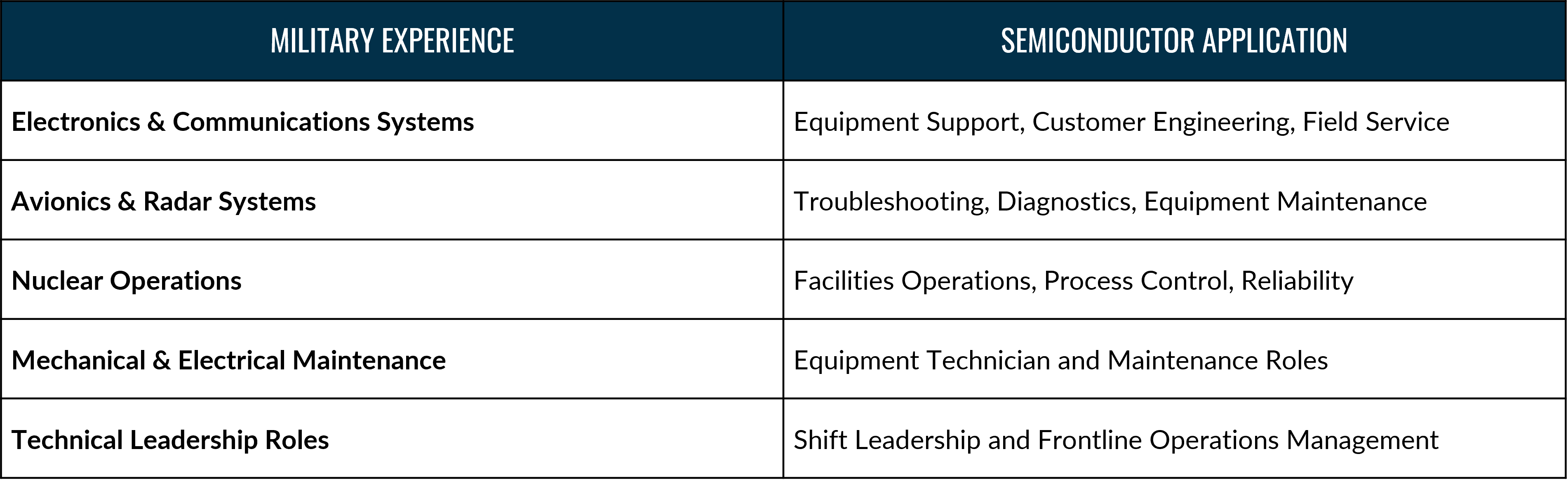
Semiconductor operations require employees who can work within highly technical, process-driven environments while maintaining strict quality and safety standards.
These same characteristics are common throughout military occupations.
Examples include:
Beyond technical skills, many veterans bring experience working in structured environments where precision, compliance, documentation, and continuous improvement are critical to mission success.
These characteristics often translate effectively into semiconductor manufacturing and operations environments.
Expanding Access to Technical Talent
The semiconductor industry's workforce challenge is not simply a matter of volume.
It is also a matter of identifying talent that can be trained, developed, and retained over time.
Military talent offers employers access to candidates who have already demonstrated the ability to learn complex systems, adapt to rapidly changing environments, and perform in roles where reliability and accountability are essential.
For organizations seeking to build sustainable workforce pipelines, this can provide an important advantage.
Rather than competing exclusively for candidates with direct semiconductor experience, employers can access a broader talent pool with many of the foundational capabilities required for success.
A Long-Term Workforce Strategy
As the industry continues to grow, workforce planning will increasingly require a combination of traditional recruiting, workforce development, skills-based hiring, and alternative talent pipelines.
Military talent is not the sole solution to the semiconductor workforce challenge.
It is, however, one of the most established and scalable sources of technical talent available today.
Organizations that incorporate military recruiting into their broader workforce strategy often find that veterans bring both technical aptitude and operational discipline that support long-term success.
Looking Ahead
Throughout this series, we've explored how semiconductor talent extends beyond semiconductor manufacturing, how workforce growth is occurring across a broader range of markets, and where employers can uncover overlooked sources of technical talent.
The common thread connecting all of these insights is that semiconductor talent is rarely confined to a single industry, geography, or background.
In our final article, we'll bring these themes together and examine why the semiconductor workforce is best understood as a broader ecosystem of transferable skills rather than a standalone labor market.
Download the Semiconductor Workforce Intelligence Snapshot to explore additional workforce trends, talent pipeline insights, labor market data, and recruiting intelligence shaping the future of semiconductor hiring.
Archives
- October 2026
- September 2026
- August 2026
- July 2026
- June 2026
- May 2026
- April 2026
- March 2026
- February 2026
- January 2026
- December 2025
- November 2025
- October 2025
- September 2025
- August 2025
- July 2025
- June 2025
- May 2025
- April 2025
- March 2025
- February 2025
- October 2024
- May 2024
- March 2024
- February 2024
- January 2024
- December 2023
- November 2023
- October 2023
- September 2023
- August 2023
- July 2023
- June 2023
- May 2023
- April 2023
- March 2023
- February 2023
- January 2023
 RSS Feed