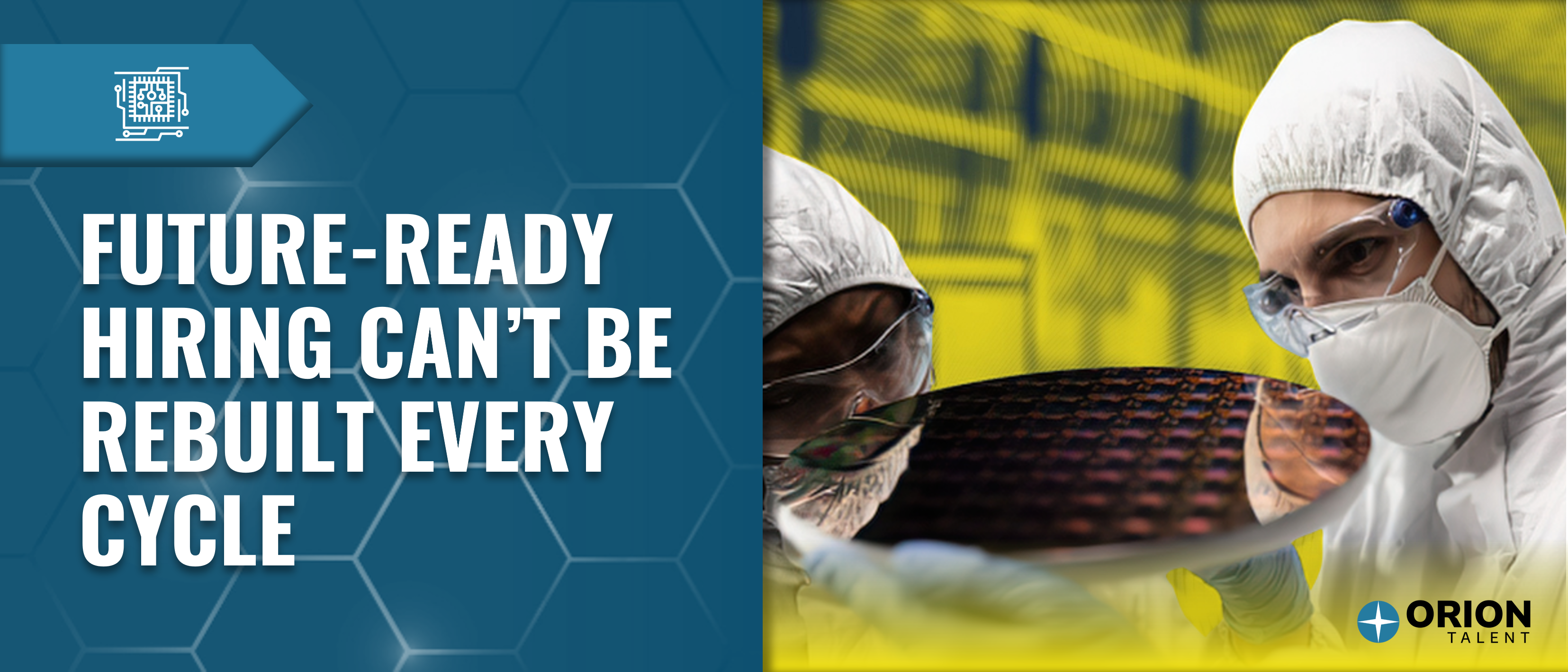
Semiconductor manufacturing has always operated in cycles. Demand accelerates, capital flows, capacity expands, and then markets recalibrate. What has changed is the structural condition of the workforce beneath those cycles. Talent scarcity is no longer a temporary imbalance that resolves during downturns. It is a persistent constraint shaped by demographic trends, increasing technical complexity, geographic expansion, and competition across advanced industries.
In this environment, hiring capability cannot be treated as a variable expense that scales down during slow periods and is rebuilt when demand returns. Workforce readiness must be continuous.
Cycles Do Not Reset the Labor Market
In prior decades, companies could pause recruiting during a slowdown and expect talent to remain within the ecosystem. Experienced engineers and technicians stayed regionally anchored and re-entered the market when hiring resumed.
Today, the dynamics are different. Experienced semiconductor professionals are retiring faster than they are being replaced. Advanced manufacturing roles increasingly require multidisciplinary capabilities. New fabrication facilities are being constructed in regions without legacy labor depth. Skilled technical professionals are actively recruited by data center, energy, aerospace, and infrastructure sectors.
When hiring infrastructure is dismantled during a downturn, rebuilding it takes time. Sourcing networks weaken, candidate pipelines shrink, internal recruiting expertise is lost, and regional partnerships lose momentum. Restarting that capability during a surge introduces delay precisely when operational timelines are least flexible.
Workforce Infrastructure Is Operational Infrastructure
Semiconductor manufacturing is engineered around redundancy, precision, and control. Workforce planning requires the same discipline.
Future-ready hiring infrastructure includes:
- Sustained sourcing capability that remains active across market cycles
- Standardized skills frameworks that define readiness consistently across sites
- Structured onboarding and certification pathways that reduce ramp variance
- Domestic pipeline strategies that expand total technical supply
- Regional ecosystem partnerships aligned to long-term production planning
- Integrated workforce forecasting that connects operational capacity models with talent acquisition
When these systems are designed intentionally and maintained continuously, hiring becomes a managed operational input rather than a reactive constraint.
From Recruiting Function to Workforce System
Many semiconductor organizations maintain capable internal recruiting teams. However, expansion phases often exceed the capacity of even strong internal functions, particularly when multiple sites are ramping simultaneously or when new regions require ecosystem development.
Future-ready hiring requires scalable systems that extend beyond individual requisitions. It requires programmatic workforce design that integrates sourcing, assessment, onboarding, regional partnerships, and performance tracking into a coordinated model.
This is where structured talent programs and Recruitment Process Outsourcing can function as strategic infrastructure rather than transactional services. When designed correctly, these programs provide continuity across cycles, preserve institutional knowledge, maintain candidate pipelines during slowdowns, and scale predictably when demand accelerates.
The objective is not to replace internal capability, but to extend it with scalable infrastructure that protects operational continuity.
Building Before the Surge
The semiconductor market will continue to evolve. Demand spikes will occur. Geographic expansion will continue. Technological complexity will increase.
The differentiator will not be which organizations react fastest to the next cycle. It will be which organizations designed their workforce systems before the cycle began.
If your organization is evaluating how to build durable hiring infrastructure that supports predictable expansion across demand cycles, we invite you to explore how integrated semiconductor talent programs can align workforce readiness with production strategy.
Learn more about our semiconductor talent solutions or complete this form to start the conversation.
Archives
- October 2026
- September 2026
- August 2026
- July 2026
- June 2026
- May 2026
- April 2026
- March 2026
- February 2026
- January 2026
- December 2025
- November 2025
- October 2025
- September 2025
- August 2025
- July 2025
- June 2025
- May 2025
- April 2025
- March 2025
- February 2025
- October 2024
- May 2024
- March 2024
- February 2024
- January 2024
- December 2023
- November 2023
- October 2023
- September 2023
- August 2023
- July 2023
- June 2023
- May 2023
- April 2023
- March 2023
- February 2023
- January 2023
 RSS Feed