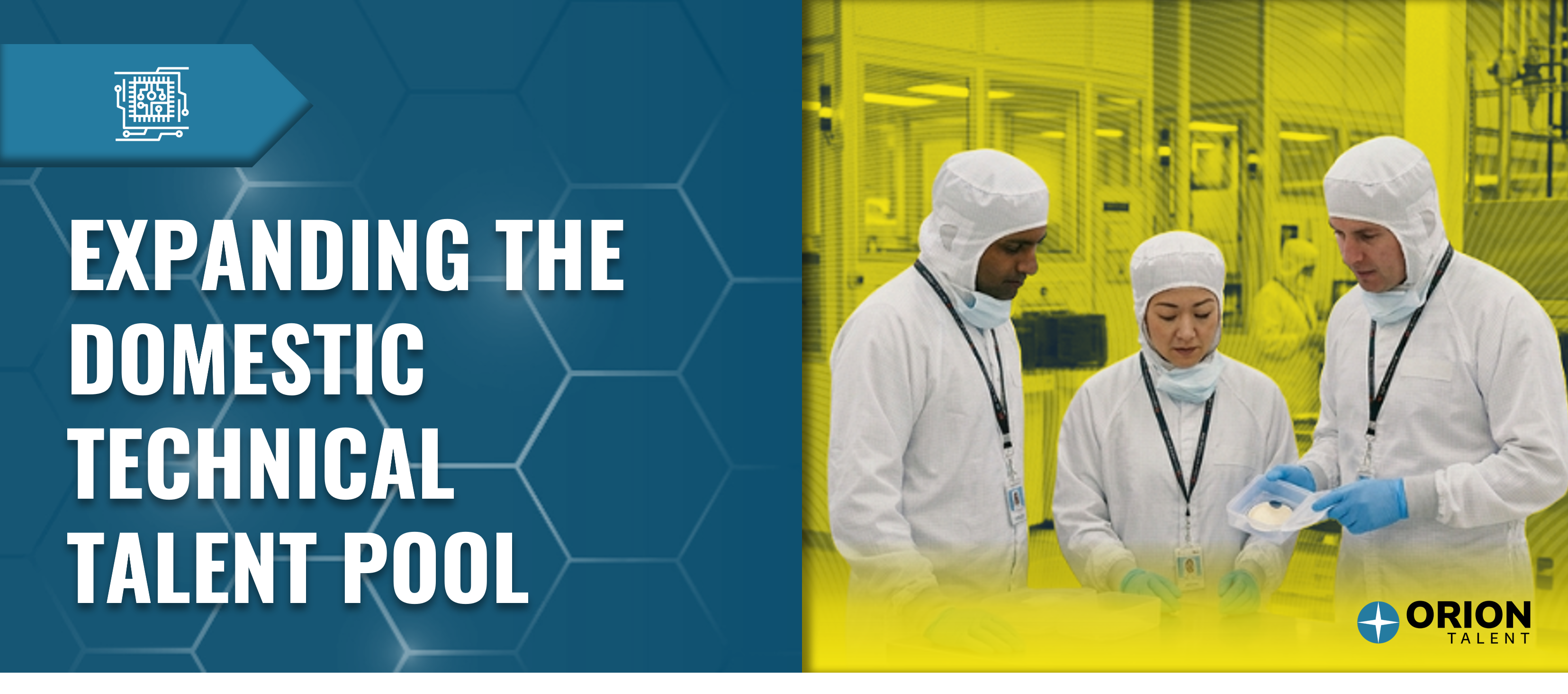
If the semiconductor talent shortage is structural rather than cyclical, then incremental sourcing tactics will not solve it. Organizations must expand the addressable technical talent pool rather than compete repeatedly for the same experienced professionals.
For many semiconductor leaders, this requires a shift from reactive hiring to deliberate domestic workforce expansion.
The Limits of Competing for the Same Talent
In established semiconductor regions, hiring strategies have historically relied on lateral movement between competitors. Engineers and technicians move between fabs, OEMs, and suppliers, carrying tool familiarity and process knowledge with them.
This model works only when the ecosystem is stable and sufficiently deep.
As fabrication expands into new geographies and as experienced professionals retire, reliance on competitor hiring becomes increasingly constrained. The number of available, directly experienced candidates is finite. In emerging regions, it may be negligible.
Competing within a limited pool does not increase supply, it just redistributes scarcity.
Domestic Supply as a Risk Strategy
Expanding the domestic technical talent pool is not a branding initiative. It is a risk mitigation strategy.
When organizations rely heavily on narrow experience criteria or policy-dependent labor channels, they introduce volatility into workforce planning. A domestic, trainable pipeline provides greater control over timing, scalability, and long-term continuity.
Domestic expansion strategies include:
- Mapping transferable technical skills from adjacent industries
- Partnering with regional technical schools and community colleges
- Developing structured apprenticeship and trainee pathways
- Investing in onboarding programs designed to accelerate time-to-competency
- Identifying disciplined technical populations whose training environments mirror semiconductor operations
This approach increases the supply of capable candidates rather than waiting for experienced talent to re-enter the market.
Military Experience as an Aligned Capability Segment
Within a domestic workforce expansion strategy, military technical talent represents one of the most structurally aligned capability segments available to semiconductor employers.
Many military occupational specialties operate in environments defined by procedural discipline, technical complexity, and zero-margin-for-error execution.
- Roles in avionics maintenance, nuclear propulsion, electronics systems, radar calibration, power generation, and advanced mechanical systems require strict adherence to standard operating procedures, contamination control, safety compliance, and systems-level troubleshooting under pressure. These conditions closely mirror semiconductor manufacturing environments where precision, documentation integrity, and disciplined execution directly affect yield and uptime.
- Military training emphasizes not only technical proficiency but also rapid skill acquisition, accountability, and performance in high-consequence settings. Technicians and operators are routinely required to qualify on new systems within compressed timelines while maintaining operational readiness standards. That learning velocity is directly applicable in fab environments where tool sets evolve and process requirements shift quickly.
- When evaluated through a skills-based lens, military candidates align strongly with semiconductor-critical roles such as equipment maintenance technicians, field service engineers, facilities specialists, and front-line manufacturing leadership. Their experience in maintaining complex systems, following controlled procedures, and operating within structured hierarchies reduces ramp risk when supported by deliberate onboarding.
Military hiring is most effective when integrated into a broader capability-based workforce strategy that maps foundational technical aptitude to semiconductor roles and provides structured pathways to certification. When executed intentionally, this approach expands the domestic pool of trainable talent while preserving performance, safety, and quality standards.
From Experience-Based Hiring to Capability-Based Scaling
Expanding the domestic talent pool requires rethinking how readiness is defined.
Traditional hiring models prioritize direct semiconductor experience. In a constrained market, this limits growth. A capability-based model evaluates core technical fundamentals and structured trainability.
Organizations that identify mechanical aptitude, electrical troubleshooting strength, procedural rigor, and cognitive adaptability can scale more effectively than those who insist on identical tool familiarity from day one.
The semiconductor industry understands manufacturing discipline. Raw materials are refined into high-performance components through deliberate process control. Workforce expansion follows a similar principle. Talent must be identified, shaped, and developed through structured systems.
Building a Sustainable Domestic Pipeline
Domestic workforce expansion is not achieved through isolated recruiting campaigns. It requires alignment between talent acquisition, operations, and workforce development.
Sustainable strategies include:
- Standardized skills frameworks for critical roles
- Structured onboarding and certification pathways
- Clear progression models to retain early-career technical talent
- Regional partnerships that align curriculum with fab requirements
- Long-term pipeline planning rather than short-term requisition response
As semiconductor expansion accelerates, domestic workforce strategy will determine which organizations scale predictably and which struggle to keep pace. Leaders who begin building structured technical pipelines now will enter the next surge with greater control, speed, and resilience.
Archives
- October 2026
- September 2026
- August 2026
- July 2026
- June 2026
- May 2026
- April 2026
- March 2026
- February 2026
- January 2026
- December 2025
- November 2025
- October 2025
- September 2025
- August 2025
- July 2025
- June 2025
- May 2025
- April 2025
- March 2025
- February 2025
- October 2024
- May 2024
- March 2024
- February 2024
- January 2024
- December 2023
- November 2023
- October 2023
- September 2023
- August 2023
- July 2023
- June 2023
- May 2023
- April 2023
- March 2023
- February 2023
- January 2023
 RSS Feed