Guest Post by Gino Marchetti
In every semiconductor cycle, hiring volumes rise and fall with capital investment and demand. It is tempting to assume that workforce pressure behaves the same way. When the market slows, hiring pauses. When the market rebounds, talent becomes scarce again.
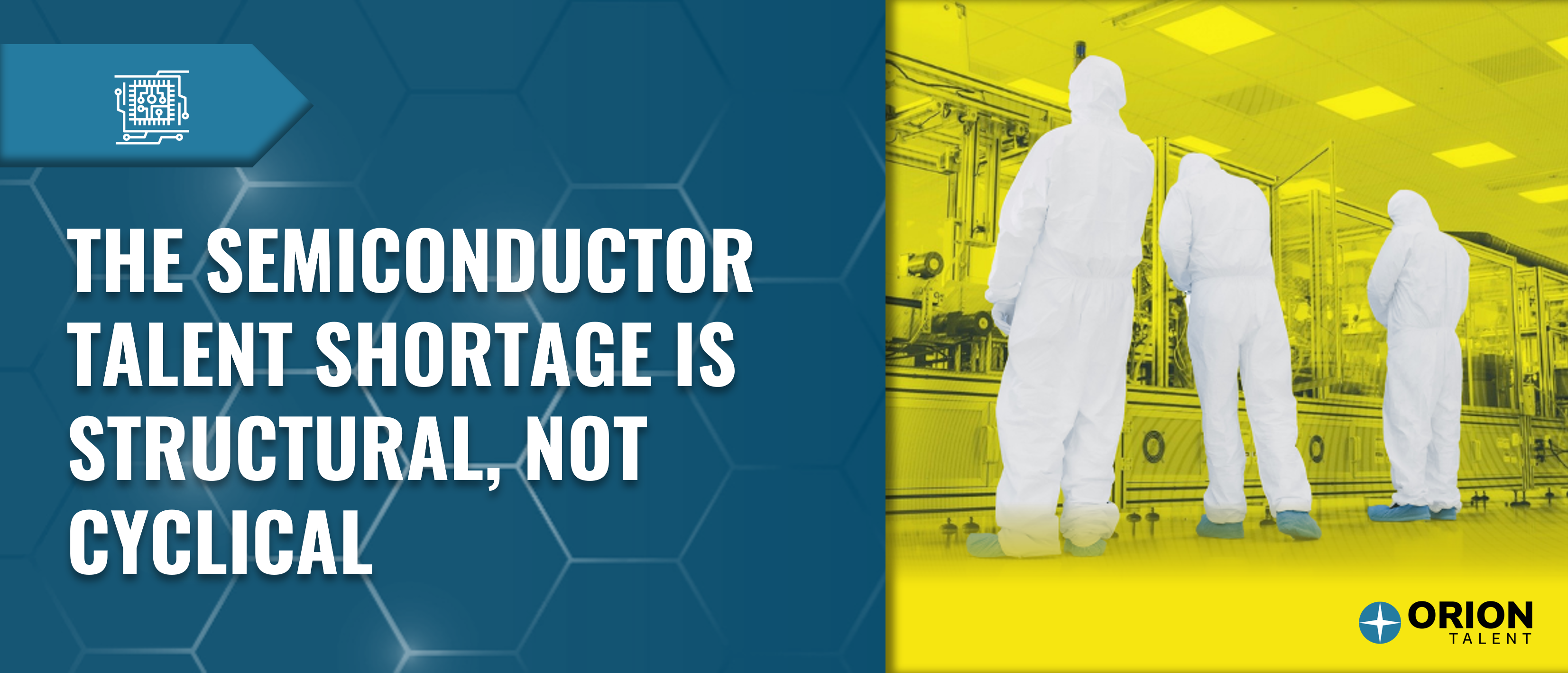
But in reality, the current talent shortage is not a temporary imbalance created by cyclical expansion. It is structural, rooted in demographic shifts, role evolution, geographic concentration, and the accelerating complexity of modern fabrication environments. Hiring slowdowns may reduce visible urgency, but they do not resolve the underlying gap between capability supply and operational demand.
Demographics Do Not Reset in Downturns
One of the clearest indicators of a structural shortage is demographic composition. Nearly 35 percent of the semiconductor workforce is over the age of 50. As experienced technicians, engineers, and equipment specialists retire, institutional knowledge leaves with them. This process continues regardless of hiring velocity.
Even during recent market slowdowns, requisitions for critical roles such as Field Service Engineers supporting advanced lithography tools or Process Engineers working at leading-edge nodes did not disappear. While broader hiring activity moderated, these roles remained persistently open because the supply of specialized technical talent was already limited.
In practical terms, the available inventory of highly skilled semiconductor professionals continues to shrink even when demand temporarily softens. When the market turns upward again, organizations are not returning to equilibrium. They are accelerating from a diminished baseline.
Role Complexity Is Accelerating Faster Than Talent Pipelines
At the same time that experienced professionals are aging out of the workforce, the roles themselves are evolving.
Modern fabrication facilities increasingly require multi-disciplinary capability. The traditional distinction between mechanical, electrical, and process roles is narrowing. As fabs move toward greater automation, data integration, and AI-driven yield management, technicians on the floor are expected to demonstrate a level of data literacy and systems thinking that was not required even five years ago.
The pace of technological advancement in semiconductor manufacturing continues to outstrip the update cycles of traditional educational institutions. College curricula can take several years to evolve meaningfully, while industry requirements may shift within 18 months. This structural lag creates a persistent capability gap that universities alone cannot close.
As a result, organizations cannot rely solely on waiting for perfectly prepared candidates to emerge from traditional pipelines. The pipeline itself is not synchronized with the industry’s rate of change.
The Cost of Treating Talent Like a Faucet
The risks of viewing workforce demand as cyclical were illustrated during the memory market downturn of 2018 and 2019. In response to declining demand, many companies paused hiring or reduced staff to manage cost exposure. During that period, skilled professionals transitioned to adjacent industries including data centers, medical device manufacturing, and electric vehicle production.
When memory demand rebounded strongly in 2020 and 2021, companies faced a different reality. Former employees had permanently exited the sector. Rebuilding capability was not as simple as reopening requisitions.
In some cases, fabrication facilities had secured the capital equipment required for expansion but lacked sufficient human capital to install, calibrate, and operationalize new tools. Equipment remained idle while organizations attempted to rebuild depleted talent pools. The financial impact extended beyond delayed hiring metrics and into lost revenue opportunity.
Treating talent as a faucet that can be turned on and off with demand overlooks the long lead times required to build high-consequence technical capability. Workforce development more closely resembles a reservoir than a tap. When reserves are depleted, they cannot be restored instantly.
Geography Compounds the Structural Gap
The expansion of domestic fabrication capacity has introduced additional structural complexity. Many new facilities are being built in regions without deep historical semiconductor labor pools. In established hubs, housing costs have risen substantially over the past decade, further limiting labor mobility.
In emerging regions, companies cannot rely on poaching talent from competitors because the local ecosystem is still forming. Workforce depth must be created, not merely transferred.
This geographic reality reinforces the need for intentional pipeline development and long-term workforce planning. Organizations that assume they will be able to source experienced talent quickly once demand accelerates may find that the regional supply simply does not exist.
Planning for a Structural Market
If leaders accept that the shortage is structural rather than cyclical, workforce strategy must adjust accordingly.
- Hiring models must incorporate longer lead times. Just-in-time recruiting exposes operations to risk when specialized roles require months or years to develop to full productivity.
- Organizations must reconsider the pursuit of the perfect candidate. In a structurally constrained market, waiting for a fully formed professional who meets one hundred percent of role criteria can delay expansion unnecessarily. Hiring for aptitude, foundational capability, and trainability, then investing in structured development, often yields more sustainable results.
- Workforce design must extend beyond recruiting teams. The companies that will perform best in the next cycle will be those that build robust pipelines of raw technical talent and invest in the training systems that transform that talent into advanced manufacturing capability.
The semiconductor talent shortage is not a temporary artifact of market timing. It is the product of demographic shifts, accelerating role complexity, geographic concentration, and structural pipeline lag.
Archives
- October 2026
- September 2026
- August 2026
- July 2026
- June 2026
- May 2026
- April 2026
- March 2026
- February 2026
- January 2026
- December 2025
- November 2025
- October 2025
- September 2025
- August 2025
- July 2025
- June 2025
- May 2025
- April 2025
- March 2025
- February 2025
- October 2024
- May 2024
- March 2024
- February 2024
- January 2024
- December 2023
- November 2023
- October 2023
- September 2023
- August 2023
- July 2023
- June 2023
- May 2023
- April 2023
- March 2023
- February 2023
- January 2023
 RSS Feed