Written by Gino Marchetti, Account Executive, Orion Talent
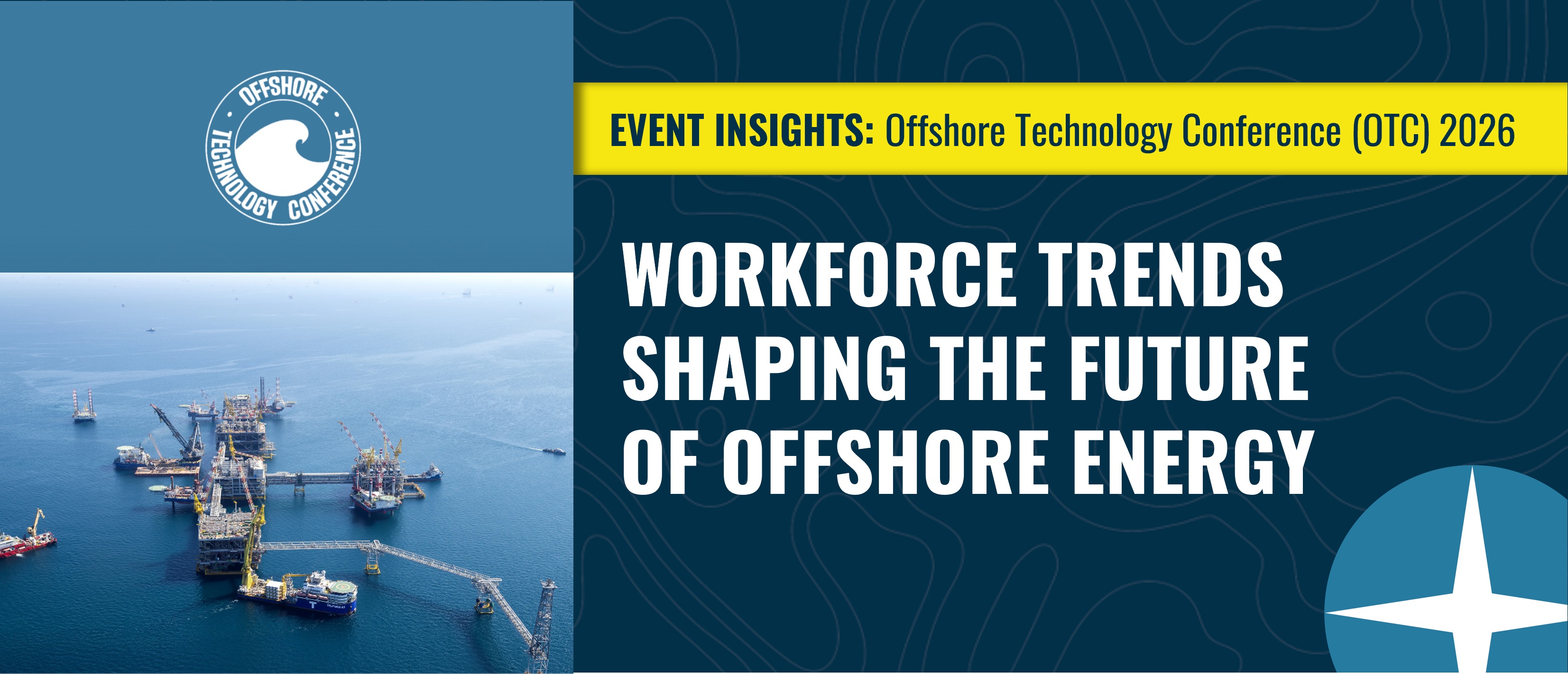
At this year’s Offshore Technology Conference 2026, one message came through consistently across panels, executive discussions, and workforce sessions: the future of offshore energy will depend as much on workforce readiness as technological innovation.
While conversations around AI, digital operations, carbon capture, and offshore infrastructure dominated the exhibit halls, the underlying challenge repeatedly surfaced in a more practical form: the American energy transition is increasingly constrained by workforce availability, mobility, and adaptability.
The offshore sector is no longer simply managing hiring demand. It is navigating a structural talent transformation that will shape project timelines, operational continuity, and long-term competitiveness over the next decade.
Workforce Strategy Is Now a Core Business Strategy
One of the strongest themes at OTC 2026 was the growing need for what many leaders described as an “integrated hub” workforce model.
The lines between traditional offshore oil and gas operations and emerging energy sectors are rapidly blurring. Deepwater projects increasingly intersect with carbon capture, utilization, and storage (CCUS), electrification initiatives, and digitally enabled remote operations.
As a result, companies are no longer hiring for narrowly defined roles. They are searching for multi-asset professionals who can operate across evolving technologies, compliance environments, and operational disciplines.
At the same time, organizations are facing renewed pressure to reshore critical technical expertise back to the U.S. Gulf Coast. Supply chain instability and geopolitical uncertainty have accelerated the push to rebuild domestic subsea engineering and fabrication capabilities. That shift is intensifying competition for highly specialized engineering and technical talent across Texas, Louisiana, and other Gulf Coast markets.
The takeaway from OTC was clear: workforce planning is no longer a downstream HR exercise. It has become foundational to operational execution.
The Offshore Industry Is Facing a Knowledge Transfer Cliff
Another major topic throughout OTC centered on the aging workforce and the urgency of knowledge retention.
According to discussions tied to 2026 GETI workforce data, professionals over age 45 now represent nearly half of the domestic energy workforce. Many organizations anticipate peak retirement activity within the next 24 months.
For offshore operators, EPCs, and service providers, this creates a significant institutional knowledge risk, particularly within subsea operations, commissioning, engineering, and field leadership functions.
At the same time, workforce mobility continues to decline. Many industry leaders noted that fewer professionals are willing to relocate for projects than in previous cycles, creating hyper-competitive regional labor markets and driving up compensation pressure for experienced technical talent.
This combination of retirement acceleration and reduced mobility is reshaping workforce strategy in several important ways:
- Companies are prioritizing retention of experienced field leadership talent longer than originally planned.
- Organizations are investing more heavily in succession planning and internal development pipelines.
- Recruiting timelines for specialized offshore roles continue to expand, particularly for passive candidates with niche operational expertise.
The concern expressed repeatedly at OTC was not simply about filling vacancies. It was about preserving operational continuity and preventing decades of offshore knowledge from leaving the workforce faster than it can be replaced.
Recruiting the Next Generation Requires a Different Message
OTC also highlighted how energy employers are evolving their recruiting approach to attract younger technical talent.
Historically, offshore recruiting often centered on field operations, project scale, and compensation opportunity. Today’s workforce messaging is becoming far more technology-driven.
Many companies shared successful recruiting strategies built around AI-enabled operations, digital twins, automation, remote operations centers (ROCs), and advanced engineering environments. Increasingly, organizations are positioning offshore energy careers as opportunities to work with some of the world’s most advanced industrial technologies rather than focusing solely on traditional rig-based narratives.
Another recurring theme was the growing importance of employee ambassador programs.
Several executive leaders emphasized that the most effective recruiting channel for the next generation is often direct engagement between experienced field professionals and technical schools, universities, and apprenticeship programs. These ambassador initiatives help demystify offshore careers while providing students with authentic visibility into modern energy operations and career pathways.
For many organizations, the challenge is no longer simply attracting applicants. It is reshaping industry perception for a workforce generation that may have limited understanding of how technologically advanced and strategically important modern offshore energy operations have become.
Talent Availability Is Now Influencing Project Decisions
Perhaps the most important strategic shift discussed at OTC was the growing integration of workforce verification into project planning itself.
Several industry leaders described how top-tier EPCs and offshore operators are increasingly evaluating workforce availability before committing to major projects. If critical subsea technicians, commissioning specialists, or engineering leadership cannot be secured through reliable pre-hiring pipelines, project execution risk increases substantially.
In many ways, talent readiness is becoming a lead KPI rather than a lagging operational metric.
This shift is also changing how organizations think about workforce transition planning. Rather than viewing traditional oil and gas talent as separate from future energy initiatives, many companies are actively mapping existing offshore competencies into emerging energy sectors.
Experienced offshore professionals already possess many of the operational, safety, compliance, and systems-management capabilities needed for CCUS, offshore electrification, and other transition-focused projects. The companies making the most progress appear to be those investing in structured reskilling pathways that allow existing workforces to evolve alongside the market.
What Offshore Leaders Should Prioritize Next
The consensus across OTC 2026 pointed toward several immediate workforce priorities for offshore and energy leaders over the next 12 to 24 months.
1. Build Structured Reskilling Pathways
With high-voltage, grid-connection, and specialized technical expertise in short supply, organizations will need to create internal training and certification pathways that allow experienced oil and gas professionals to transition into adjacent energy disciplines.
2. Rethink Retention Beyond Compensation
Many leaders acknowledged that salary growth alone is becoming less effective as a retention strategy. More organizations are exploring rotational flexibility, “offshore-light” schedules, and family-focused benefits to improve long-term workforce stability and retention.
3. Strengthen Strategic Talent Partnerships
As hiring timelines for specialized offshore positions continue to stretch, many companies are reassessing traditional staffing models. The need for consultative recruiting partners with deep understanding of offshore compliance, technical operations, and passive talent engagement was a consistent theme throughout workforce discussions at OTC.
Final Takeaway
The conversations at OTC 2026 reinforced that offshore energy companies are entering a new workforce era.
Technology innovation remains critical, but the organizations best positioned for long-term success will be those that treat workforce strategy as operational infrastructure rather than administrative support.
The industry’s ability to execute major offshore and energy transition projects will increasingly depend on how effectively companies retain institutional expertise, develop next-generation technical talent, and create scalable workforce pipelines capable of supporting a rapidly evolving energy landscape.
Archives
- September 2026
- August 2026
- July 2026
- June 2026
- May 2026
- April 2026
- March 2026
- February 2026
- January 2026
- December 2025
- November 2025
- October 2025
- September 2025
- August 2025
- July 2025
- June 2025
- May 2025
- April 2025
- March 2025
- February 2025
- October 2024
- May 2024
- March 2024
- February 2024
- January 2024
- December 2023
- November 2023
- October 2023
- September 2023
- August 2023
- July 2023
- June 2023
- May 2023
- April 2023
- March 2023
- February 2023
- January 2023
 RSS Feed