Manufacturers are not struggling to understand the value of military talent. The challenge is translating that intent into a strategy that consistently delivers results.
Across advanced manufacturing, organizations are recognizing that workforce constraints are not just a recruiting issue, they are an operational risk. Talent gaps slow production, delay ramp timelines, and place additional strain on already stretched teams. At the same time, the external environment continues to shift. Retirements, automation, and evolving skill requirements are reshaping the workforce faster than traditional hiring models can keep up.
Military talent represents one of the most scalable and aligned workforce channels available today. Each year, approximately 200,000 service members transition from active duty, bringing technical capability, leadership experience, and a strong foundation in process discipline.
Yet despite this opportunity, many organizations struggle to fully operationalize military hiring. The issue is rarely access to talent. It is the absence of a clearly defined, end-to-end strategy.
Why Most Military Talent Strategies Stall
In many cases, companies approach military hiring as a sourcing initiative rather than a workforce strategy. Efforts tend to be episodic, focused on individual hiring events, partnerships, or roles, without the structure needed to scale.
This often leads to familiar challenges:
- Candidates are sourced, but not effectively translated into relevant roles
- Hiring managers default to “perfect fit” expectations instead of evaluating capability
- Processes are not aligned to military transition timelines
- Early success does not convert into long-term retention or pipeline strength
The result is inconsistency. Organizations may see pockets of success, but they do not build the repeatable system required to support growth.
From Hiring Tactic to Workforce Strategy
The most effective organizations take a different approach. They treat military talent as part of a broader workforce design that spans the full talent lifecycle and aligns to business outcomes.
This requires moving from reactive hiring to proactive pipeline development, where talent is identified, engaged, and developed ahead of demand.
It also requires a shift in how talent is evaluated. Military candidates rarely present as a direct match on paper, but they often bring adjacent skills, learning agility, and leadership capability that align strongly with manufacturing environments. Organizations that adopt a skills-first approach are better positioned to convert this potential into performance.
A Framework for Assessing Your Strategy
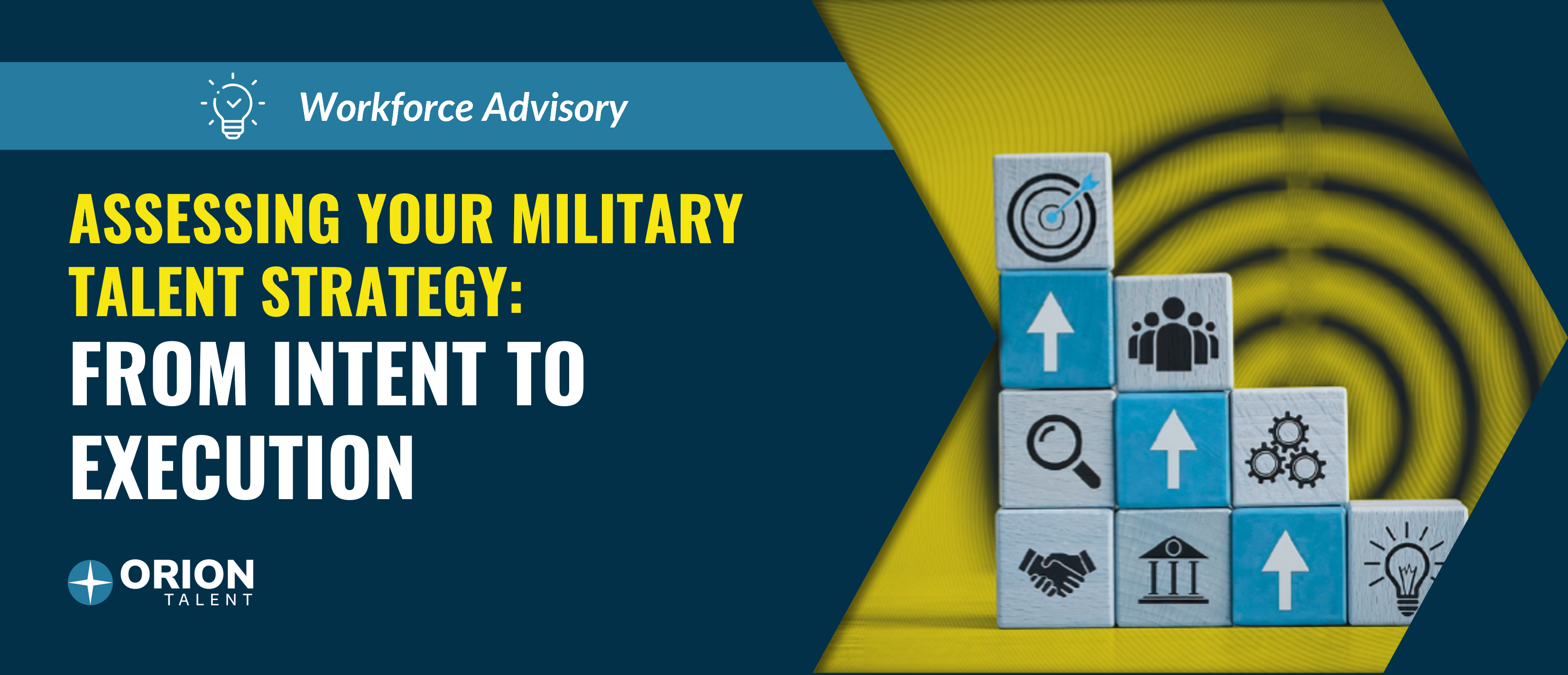
A comprehensive military talent strategy must be evaluated across four interconnected areas:
1. Attract
Are military candidates finding your opportunities and understanding how their experience applies?
This includes how your employer value proposition resonates with military talent, your presence within military communities, and your ability to clearly translate roles and expectations.
2. Hire
Are your processes enabling the right candidates to move forward efficiently?
This is often where breakdowns occur. Manager alignment, consistent evaluation criteria, and decision speed all play a critical role in converting interest into hires.
3. Develop
Are new hires set up for success during transition and onboarding?
The first 90 days are particularly important. Structured onboarding, clear expectations, and early manager engagement significantly impact time to productivity and long-term retention.
4. Retain
Are you creating an environment where military talent can grow and stay?
Retention is driven by clarity of career paths, connection to purpose, and a sense of belonging. Without these elements, even strong hires may disengage over time.
Organizations that build capability across all four areas are able to move beyond isolated hiring wins and establish a durable, scalable talent pipeline.
What This Means for Workforce Leaders
For CHROs, talent leaders, and operations executives, the question is no longer whether to invest in military talent. The question is whether your current approach is structured to deliver consistent outcomes.
Assessing your strategy requires looking beyond hiring volume and examining how well your organization is designed to:
- Translate military experience into business-relevant capability
- Align hiring teams around skills-based evaluation
- Engage candidates early in their transition timeline
- Support onboarding, development, and long-term retention
In many cases, small structural changes—particularly in role definition, manager alignment, and candidate experience—can significantly improve results.
Start with a Structured Assessment
The most effective way to move forward is to establish a clear baseline.
A structured Military Talent Strategy Assessment provides visibility into where your current approach is working, where it is breaking down, and where the greatest opportunities exist to improve performance. It evaluates your strategy across attract, hire, develop, and retain, and identifies practical, actionable steps to strengthen your pipeline and outcomes.
This is not about rebuilding your approach from scratch. It is about refining and aligning what already exists so it can scale with your business.
Are You Ready to Assess Your Military Talent Strategy?
If you are looking to strengthen your workforce strategy and better leverage military talent, we invite you to take the next step.
Request a complimentary Military Talent Strategy Assessment to evaluate your current approach and identify clear, practical opportunities to improve outcomes across your hiring lifecycle.
Archives
- October 2026
- September 2026
- August 2026
- July 2026
- June 2026
- May 2026
- April 2026
- March 2026
- February 2026
- January 2026
- December 2025
- November 2025
- October 2025
- September 2025
- August 2025
- July 2025
- June 2025
- May 2025
- April 2025
- March 2025
- February 2025
- October 2024
- May 2024
- March 2024
- February 2024
- January 2024
- December 2023
- November 2023
- October 2023
- September 2023
- August 2023
- July 2023
- June 2023
- May 2023
- April 2023
- March 2023
- February 2023
- January 2023
 RSS Feed