
Written by Jericho Urmenita, Intelligence & Strategy, Orion Talent
Your LinkedIn profile is often your first impression with a military recruiter. And I have seen enough profiles in this job to tell you, there’s is a right way and a wrong way. The examples below are all real and they work.
Let's make yours work.
Put "Transitioning..." Somewhere in Your Title
This is the most direct signal to recruiters that you are getting out. Add your EAS/ETS date if it's within 12 months — it creates urgency. A recruiter who sees you're separating in 60 days will prioritize contacting you over someone with no date listed.
Use Your Actual Billet Titles
Not civilian-sounding approximations of them. Your billet titles help a recruiter read your career path immediately: did you do a standard tour, staff billets, IA deployments? That context shapes how we can translate your skills.
It should look like this: Executive Officer, Operations Officer, G3 Plans Officer
Not like this: Advisor to CEO, Operations Director, Senior Operations Executive
The gray area: sometimes a parenthetical works.
- Transportation Platoon Commander (Distribution Supervisor)
- Logistics Company Commander (Logistics Manager)
Use this sparingly, and only if you have a clear understanding of civilian org structure and scope.
Know Where You Map on the Civilian Org Chart
This is one of the most common calibration issues I see. Here's a general structure for any large manufacturing company:
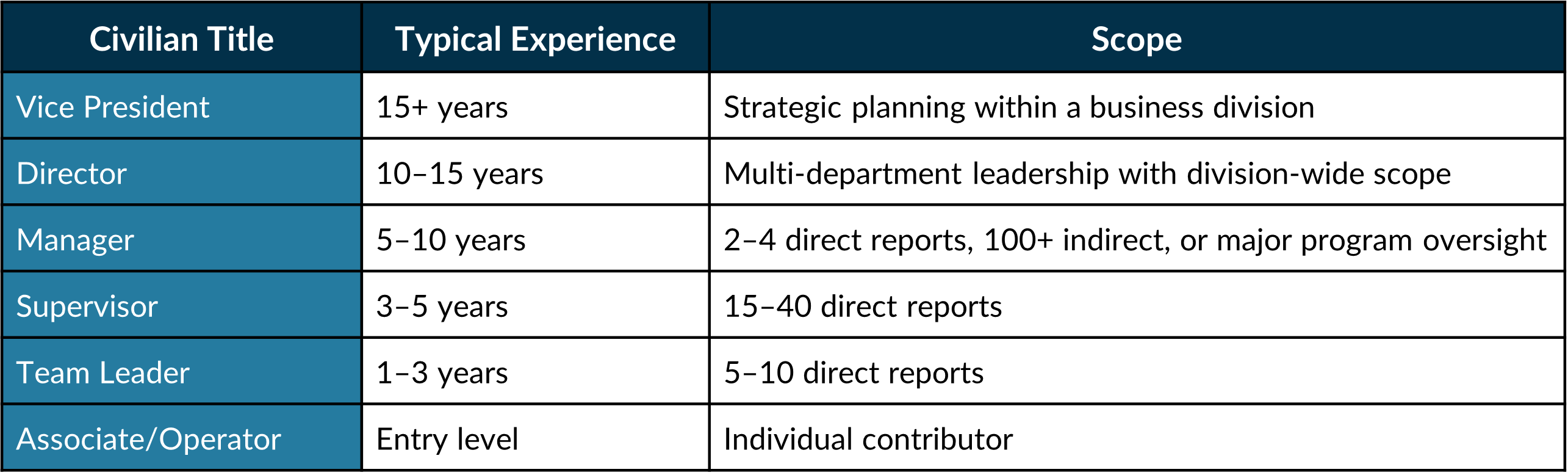
A few important notes: I generally suggest only Battalion Commanders and above use the Director translation due to scope. VP and above are generally not advised — those require business acumen that is difficult to demonstrate without civilian industry experience.
Don't Sound Higher Speed Than You Are
Seasoned military recruiters will catch it immediately. And it's better to catch it with us than have it come out in front of a hiring manager. A few common ones to avoid:
- FiST, Sappers, UAV operators: These may attach to SOF, but they are NOT, SOF. Do not use "Special Operations" for any of these.
- Platoon Sergeant: If you were an SNCO and there was a commissioned officer over you, you were the Platoon Sergeant, not the Platoon Commander. That title is solid (some would say even better). Own it.
- "Command over 500 personnel": Usually for Battalion Commanders and above only. Operations Officers did not command 500 personnel. Watch your terminology — it matters to a prior military hiring manager.
Keep Your Titles Simple
Use the one title you have on your evals for each heading. Keep collateral billets collateral.
It should look like this: S4 Logistics Officer
Not like this: Chief of Procurement / Warehouse OIC / Battalion SAPR Rep / Command Historian
Don't Write Bullet Points Like Award Citations
"Audaciously seized the objective" is great on a FITREP. On LinkedIn, it clouds the things a hiring manager is actually looking for: team size, dollar value of contracts, volume of assets moved, problems solved, decisions made.
Education Section: Keep It Clean
Keep: Bachelor's degrees, Master's degrees, civilian certs like LEAN Six Sigma, PMP, SHRM.
Leave off: Required career progression schools (TBS, IOC, CCC), required training (SAPR, Cyber Awareness, Rifle Qual).
Gray area: High-visibility schools like Ranger School, BUD/S, Jump School, Dive School can stay — they signal above-and-beyond performance and are particularly useful for sales and business development roles.
Location Setting
If your post-military move is imminent, set your location to your destination — not your current duty station. Many recruiter searches are regional, and you want to show up in the right market.
Archives
- October 2026
- September 2026
- August 2026
- July 2026
- June 2026
- May 2026
- April 2026
- March 2026
- February 2026
- January 2026
- December 2025
- November 2025
- October 2025
- September 2025
- August 2025
- July 2025
- June 2025
- May 2025
- April 2025
- March 2025
- February 2025
- October 2024
- May 2024
- March 2024
- February 2024
- January 2024
- December 2023
- November 2023
- October 2023
- September 2023
- August 2023
- July 2023
- June 2023
- May 2023
- April 2023
- March 2023
- February 2023
- January 2023
 RSS Feed