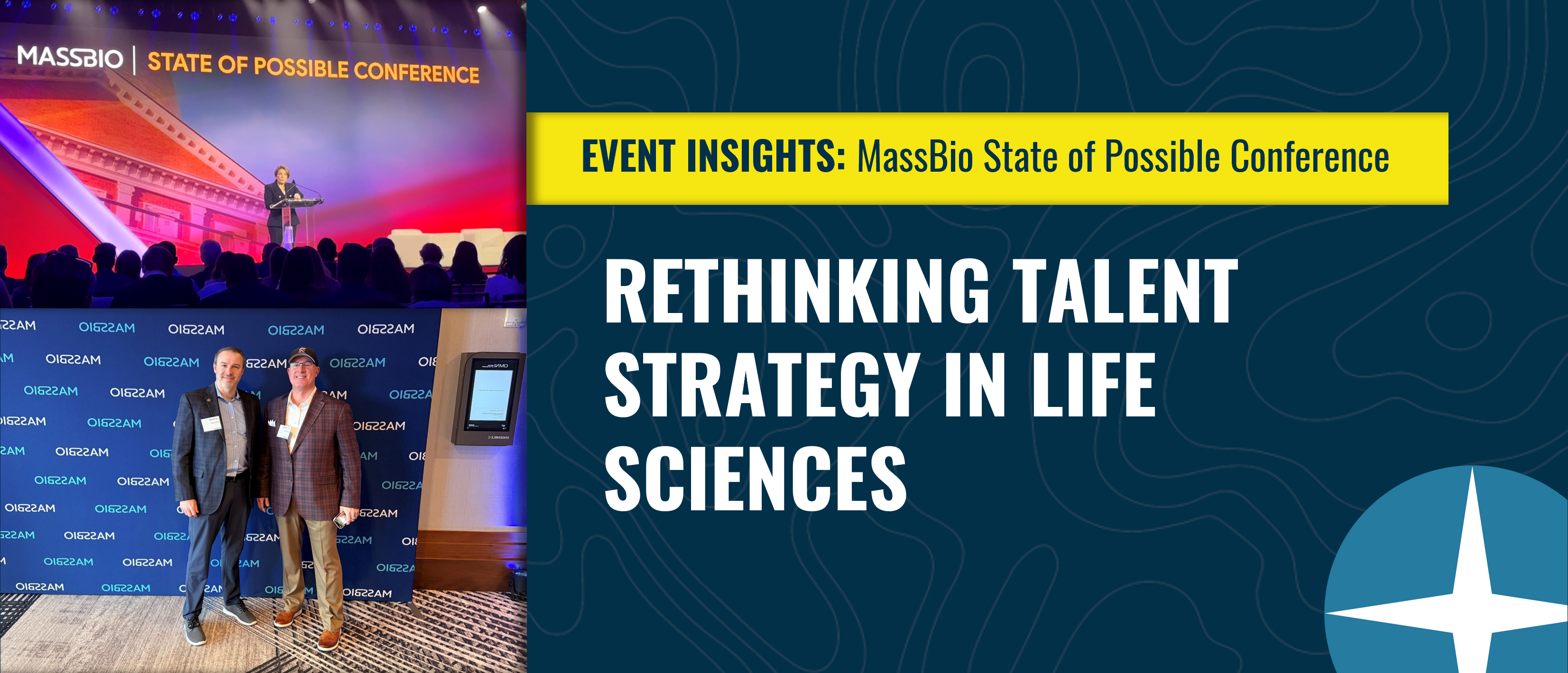
Written by Butch Hawking, Account Executive, Orion Talent
In late March, I attended the MassBio State of Possible event in Boston with my colleague Tim Sweeney, joining one of the most concentrated gatherings of leaders across the biotech and life sciences ecosystem.
The conversations were candid, the tone was grounded in reality, and the message was clear. The industry is navigating a period of constraint and uncertainty, but the long-term mission has not changed.
Below are the key themes I heard and what they mean for how organizations should be thinking about talent strategy and workforce planning right now.
The Mission Is Steady But the Environment Is Not
Across sessions and conversations, one theme came through consistently. The “why” remains deeply intact.
Biotech leaders are still driven by the ability to impact patients and extend lives. That purpose continues to anchor the industry even as external pressures mount.
At the same time, the operating environment has shifted. There have been hundreds of layoffs across the Massachusetts life sciences ecosystem over the past two years. Funding constraints persist and fundraising cycles are longer. Regulatory uncertainty continues, including evolving FDA expectations. Costs across research, development, and operations are rising.
There is also a strong counter-theme. There is an unwavering belief that rigorous science, resilience, and persistence will ultimately win.
What this means for talent strategy is that organizations must operate in two realities at once. There is short-term constraint and long-term conviction. Talent strategies that are purely reactive to current conditions will fall short. The companies that win will continue to invest in critical talent aligned to their long-term scientific and commercial goals.
The New Reality of Uncertainty
One of the clearest signals from the event was the loss of predictability.
Leaders are navigating unclear timelines, shifting policies, and higher and more complex approval thresholds. Despite this, the prevailing mindset was not retreat. It was resilience.
Teams are smaller and leaner today, but there is recognition that hiring will need to accelerate again. The difference is that future hiring will be more targeted, more selective, and more closely tied to outcomes.
What this means for workforce planning is that static hiring plans no longer work. Organizations need more dynamic, scenario-based workforce strategies that allow them to scale up quickly when conditions shift. Many companies will struggle here, not because they lack access to talent, but because they lack the infrastructure to move quickly when the window opens.
An Employer-Driven Market Has Reshaped Talent Dynamics
The talent market in life sciences has fundamentally shifted.
What was once candidate-driven is now employer-driven. There is a surplus of experienced talent due to sustained layoffs. Hiring cycles are slower and companies are more selective. There are fewer open roles and more competition for each opportunity. Talent is also expanding its geographic scope beyond traditional hubs like Boston.
At the same time, structural challenges remain. The cost of talent in major markets remains high. Lab vacancy rates have surged. There is continued uncertainty around NIH and government funding.
What this means for TA leaders is that access to talent is no longer the primary constraint. Precision is.
This is a moment to shift from volume-based recruiting to highly targeted, skills-aligned hiring. The organizations that can clearly define what “right talent” looks like and move decisively will have a significant advantage.
Talent Is the Differentiator Right Now
One of the most important takeaways from the event was a simple but critical reminder. Even in a constrained environment, performance still comes down to people.
With delayed programs, asset prioritization, and pricing pressures, many organizations are focused on de-risking their portfolios. Talent is often underweighted in that equation.
This environment presents a unique opportunity. High-quality talent is available. Competition for that talent is temporarily reduced. Organizations can strengthen their teams ahead of the next growth cycle.
What this means for leadership teams is that waiting to hire until conditions improve is a risk.
Forward-looking organizations are using this moment to identify and secure top-tier talent, often before a formal opening exists. They are building bench strength and positioning themselves to move faster than competitors when the market turns.
What Leaders Should Do Next
Based on what we heard, there are three clear actions for CHROs, TA leaders, and operations leaders over the next 6 to 12 months.
First, stay in the market for talent even without open roles. The best organizations are always evaluating talent. This is not a post and wait environment. It is a proactive search for high-impact individuals who can accelerate outcomes.
Second, build bench strength ahead of demand. Turnover will continue and hiring needs will return, often quickly. Organizations that have a pipeline of pre-qualified, engaged talent will have a significant advantage.
Third, shift to precision hiring. In a capital-constrained environment, every hire matters more. Align hiring tightly to business-critical priorities and ensure the process is designed to identify and secure the right capabilities, not just fill roles.
Final Thought
The current environment in life sciences is challenging. It is also creating a moment of separation.
Some organizations are pulling back and waiting for clarity. Others are moving forward, refining their talent strategies, strengthening their teams, and positioning for what comes next.
The science will continue to advance; and the question is, which organizations will have the talent in place to advance with it.
If these themes reflect what you are seeing in your organization, we would welcome a conversation to discuss your talent priorities and how to position for what comes next.
Archives
- October 2026
- September 2026
- August 2026
- July 2026
- June 2026
- May 2026
- April 2026
- March 2026
- February 2026
- January 2026
- December 2025
- November 2025
- October 2025
- September 2025
- August 2025
- July 2025
- June 2025
- May 2025
- April 2025
- March 2025
- February 2025
- October 2024
- May 2024
- March 2024
- February 2024
- January 2024
- December 2023
- November 2023
- October 2023
- September 2023
- August 2023
- July 2023
- June 2023
- May 2023
- April 2023
- March 2023
- February 2023
- January 2023
 RSS Feed