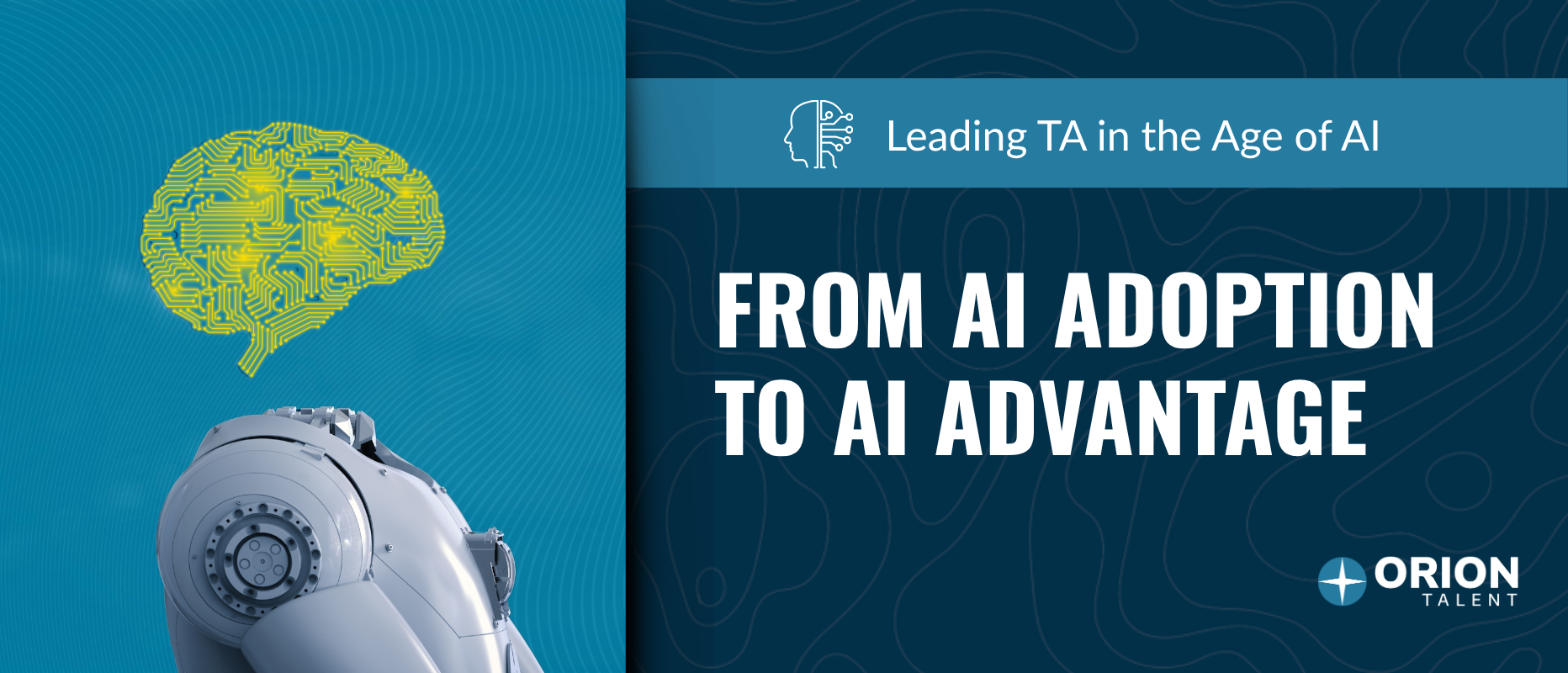
Adopting AI is becoming easier. New capabilities are appearing in existing recruiting platforms, while standalone tools can be tested quickly. Teams can begin generating content, automating tasks, identifying candidates, or analyzing data with little effort.
Creating a lasting advantage is much harder. Access to AI will not differentiate an organization when similar technology is widely available. True competitive advantage will result from effective application, faster learning, and more consistent improvement.
Moving from AI adoption to AI advantage requires talent acquisition leaders to treat AI as a business capability that must be developed over time.
Look Beyond Tool Adoption
Early AI efforts often focus on enabling a feature or launching a pilot. Those steps are necessary, but they measure activity rather than maturity.
A tool may save time without changing how the function operates. It may increase candidates identified or messages sent without improving quality, engagement, or hiring outcomes. It may also remain isolated because the organization lacks the process, data, training, or governance needed to scale it.
AI creates strategic value when it helps talent acquisition solve business problems, improve workforce insights, expand access to talent, strengthen decisions, and redirect recruiter capacity toward higher-value work.
The question shifts from “Where are we using AI?” to “What are we able to do better because of it?”
Build Organizational Capability
Sustainable advantage does not reside in the technology alone, it depends on the capabilities built around it.
Recruiters need the fluency to use AI and the judgment to challenge its outputs. Managers must coach new behaviors and monitor quality. Leaders must set priorities and connect AI initiatives to business goals. Cross-functional partners must support responsible implementation.
Clean data, defined workflows, integrated systems, and clear ownership allow successful use cases to move beyond individual experimentation. Without that foundation, organizations may accumulate tools without strengthening talent acquisition.
Capability grows when people know what is expected, have the resources to deliver it, and can apply what they learn across the team.
Create a Continuous Learning Cycle
AI adoption cannot be managed as a one-time implementation. Tools change, models evolve, data shifts, and new use cases emerge. The organization’s approach must evolve as well.
Teams should establish a repeatable cycle for testing, learning, and improving:
-
Identify a specific business problem.
-
Define the desired outcome and baseline.
-
Test the use case within a controlled scope.
-
Review performance, risk, and user feedback.
-
Refine, scale, or discontinue the approach.
This cycle turns experimentation into organizational learning. It also prevents teams from continuing to use a tool simply because it has already been purchased or implemented.
Recruiters should regularly share what is working, where outputs fall short, and how users respond. Those insights can reveal opportunities and risks dashboards may miss.
Balance Innovation With Responsible Governance
Competitive pressure can create a false choice between moving quickly and governing responsibly, but organizations need both.
Clear governance defines approved uses, information boundaries, human review requirements, and escalation paths. Those guardrails can support faster experimentation by removing uncertainty.
Governance must also keep pace with use. A low-impact productivity tool may require different oversight than technology that screens or ranks candidates. As a use case expands or begins to influence more consequential decisions, the level of testing, documentation, monitoring, and accountability should increase.
Responsible innovation is not only about reducing risk. It protects the trust of candidates, recruiters, and hiring managers, making long-term adoption more sustainable.
Turn Learning Into Competitive Advantage
The organizations that gain the greatest advantage from AI will not necessarily be those that began first or bought the most technology. They will be those that learn faster and translate that learning into better ways of working.
That can mean identifying overlooked talent, providing stronger market intelligence, improving candidate experiences, and enabling recruiters to become strategic advisors. These gains are difficult to replicate because they reflect the organization’s people, processes, data, and leadership.
AI advantage is not an end state that an organization reaches, but rather it’s the ongoing ability to adapt as technology and talent markets change.
To learn how Orion Talent can help your organization turn AI capability into a sustainable advantage, contact our team to start the conversation.
Archives
- October 2026
- September 2026
- August 2026
- July 2026
- June 2026
- May 2026
- April 2026
- March 2026
- February 2026
- January 2026
- December 2025
- November 2025
- October 2025
- September 2025
- August 2025
- July 2025
- June 2025
- May 2025
- April 2025
- March 2025
- February 2025
- October 2024
- May 2024
- March 2024
- February 2024
- January 2024
- December 2023
- November 2023
- October 2023
- September 2023
- August 2023
- July 2023
- June 2023
- May 2023
- April 2023
- March 2023
- February 2023
- January 2023
 RSS Feed